Shaping the future with textiles
The Swiss textile and clothing industry is developing the textile solutions of tomorrow. It brings together research, development, design, production, retail and the circular economy to form a leading international centre of excellence. Its SMEs embody innovation, specialisation and entrepreneurial expertise – from high-tech applications in medicine, mobility and industry to sustainable materials and high-quality consumer goods. It is precisely this diversity that gives the sector its particular strength and makes it a major player with a global impact.
A unique wealth of ideas, high quality and distinctive products form the basis for the success of Swiss textile companies operating on the international stage.
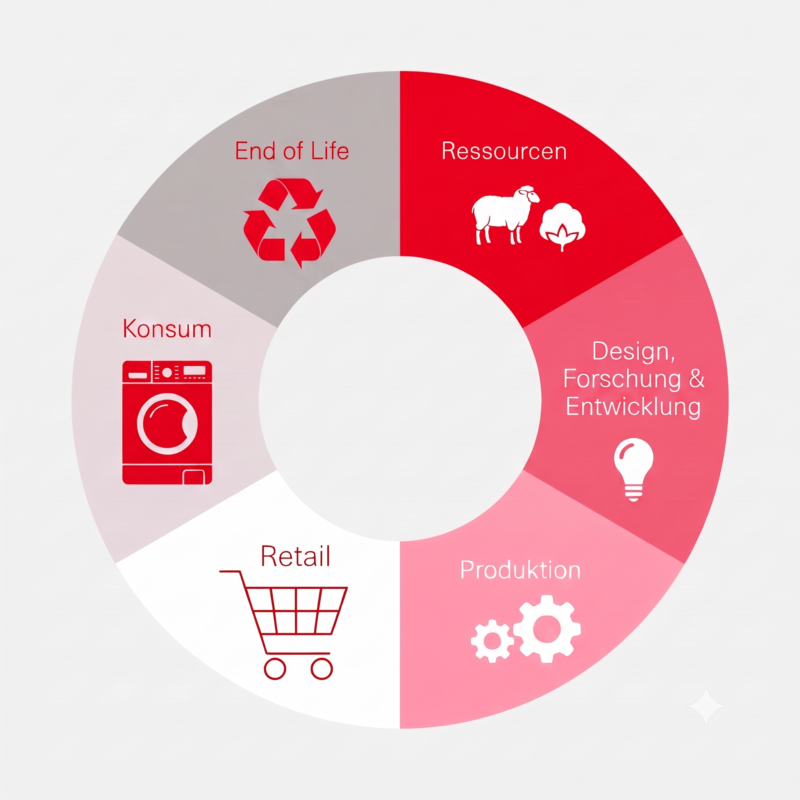
Value creation cycle
Textile value creation can be understood as a cycle that encompasses the entire life cycle of a textile product. This is because, before a finished product is created, it passes through several stages of production before reaching the end consumer. It is a sequence of numerous work steps involving resources, producers, suppliers, garment manufacturers, logistics companies and retailers along a global value chain.
We encounter textiles everywhere in our daily lives. Not only in the form of clothing, but also carpets, seat covers, medical products, filters for smartphones, lightweight components in the automotive industry and insulation materials in buildings – all are made from fibres, yarns and textile fabrics.
1. Resources
The value chain begins with resources – the cultivation of natural fibres such as cotton or wool, and the development and production of synthetic or cellulosic fibres.
2. Design, Research & Development
The design phase encompasses not only product development but also research and innovation. It is at this stage that key decisions are made regarding a product’s circularity. This is achieved, for example, through the choice of materials, the product’s structure, or by factoring in subsequent reuse and recycling.
3. Production
Production encompasses all processing stages – from spinning, knitting, weaving and finishing right through to garment manufacturing.
4. Retail
The term ‘retail’ encompasses all distribution and logistics processes, in both the B2B and B2C sectors, as well as in brick-and-mortar and digital retail.
5. Consumption
The penultimate step describes the use of the products by business or private customers.
6. End of Life
The cycle ends with the ‘End of Life’ stage, in which textiles are collected, sorted and, depending on their quality, reused, recycled or otherwise recovered. The aim of a functioning circular economy is to return as many materials as possible to the value chain as raw materials after use, thereby reducing the demand for primary resources.