Member News
HSLU pilot project mechanically recycles used workwear
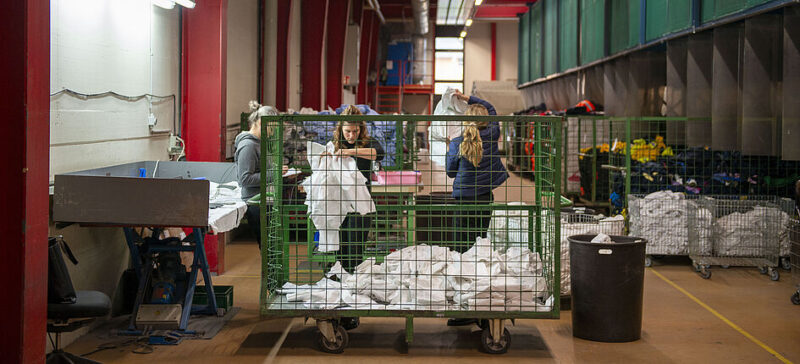
(CONNECT) In fundamental terms, it is possible to recycle used workwear. This has been shown in a study conducted by the Product & Textile research group at the Lucerne University of Applied Sciences and Arts (HSLU), as detailed in a statement. As part of the pilot project, new fabrics were created that contain up to 39 percent recycled materials.
A whole host of industrial partners took part in the project, which received funding from Innosuisse, the Swiss Innovation Agency. These included Hüsler Berufskleider AG from Sirnach in the canton of Thurgau, which developed uniforms worn by nursing staff that have been optimized for the circular economy. CWS-boco Suisse SA, with its Swiss headquarters in Opfikon in the canton of Zurich, supplied materials and contributed its expertise in the area of industrial laundry. Texaid, a company from Schattdorf in the canton of Uri, collected and sorted the discarded textiles. The data specialist Datamars, which hails from Lamone in the canton of Ticino, developed data sharing models deployed across the value chain. Finally, Coop, one of Switzerland’s largest retail and wholesale companies, the mechanical engineering company Säntis Textiles from Bühler in the canton of Appenzell Ausserrhoden, and Sustainable Textiles Switzerland 2030 all contributed their expertise as well.
In addition, the project highlighted the barriers standing in the way of a circular textile economy. For one thing, the quality of new fabrics needs to be improved in order to satisfy the demands on workwear. Above all, however, costs must be reduced. Better networking among stakeholders, circular design strategies and the tracking of material flows and data can all help in this regard. “As long as recycled fibers are more expensive than virgin fibers, incineration plants will be the main competition for a circular economy in the textile industry, even if the industry itself is quite committed”, as Tina Tomovic, an expert in textile lifecycles and lecturer at HSLU, comments in the statement.
In a separate interview, Andrea Weber-Hansen points out that we are still only at the beginning of the journey as far as recycling textiles is concerned. “In effect, there is no such thing as textile recycling yet”, the professor and head of the Product & Textile Competence Center explains. At present, there are no industrial-scale methods for processing textile fibers in such a way that “new, high-quality fibers can be produced”. ce/ug