Member News
New “supergut” podcast episode from Hilti focuses on Neumühle mono textiles
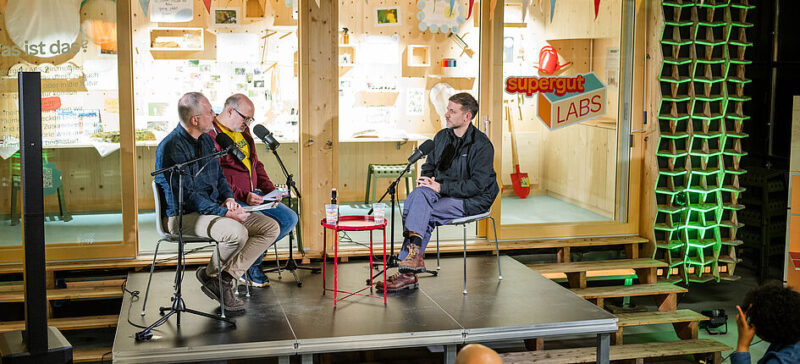
(CONNECT) “What makes one white t-shirt different from another?” is the question posed by Neumühle co-founder Andreas Fehr in the latest episode of “supergut”, a podcast series from the Liechtenstein-based Hilti Foundation on the subject of biodiversity. It cleverly distils a core consideration of the Neumühle marketing strategy. After all, a customer cannot tell from looking at the textile products of the sustainable fashion label that they represent maximum circularity and can be recycled in their entirety. This unique approach was launched in 2023 as the result of a development process funded by Innosuisse, the Swiss Innovation Agency.
For example, the Mono Shirt does not need to be taken apart to recover the materials used. It contains no elastane or polyester yarn. As Fehr underlines, this can only be possible when products are conceived and designed with the circular economy in mind right from the outset. Worn shirts can be returned to Neumühle, then Säntis Textiles recycles them without using chemicals or water and processes them into fresh yarn. Customers are then rewarded with a 20 percent discount on their next purchase for returning the shirt. “Finding a narrative for all of this that clearly resonates with a target group is a real challenge”, Fehr states.
However, the understated design and clear lines of Neumühle garments can also speak for themselves, he says. “These are supposed to be everyday products that consumers enjoy wearing and they don't need to be reminded of what it exactly contains because that should just be the standard”. Anyone interested in finding out more can head to website or drop by the Zurich store; a wealth of information is reportedly available in each case.
In the podcast episode, Fehr comments in some detail on his motivation for the path he is taking with Neumühle, pointing out that while Switzerland may be a world champion in recycling, it is also a global leader in producing waste. He explains that he is keen to play his part in changing this situation. With regard to the “fast fashion” trend, Fehr is somewhat puzzled by the inability to recycle such garments as well as the social angle to ridiculously low prices: “Consumers pay price X”, he says, “but someone has to pay the costs that are not factored in. And this falls on the people making the clothes in the first place as well as the environment”.
Where social or environmental sustainability values are not aligned, the Neumühle team has also declined cooperation enquiries, which from a marketing perspective would have been “incredibly exciting and even international” in nature, Fehr reports. “But I hope that when we sat down with the Heads of Design, we might have inspired them to adopt a more sustainable approach to their operations”. ce/mm